Last updated: October 2026
By Shani Patel of Patel Events
Planning a wedding abroad adds distance to every ordinary wedding decision. The venue must work for the ceremony and the guest journey; suppliers must understand the destination’s rules; and family members need clear information before they commit to flights, rooms, outfits, and time away from home. A useful destination wedding checklist turns those connected decisions into an order of work.
This guide is written for couples in London and elsewhere in the UK who may be planning celebrations in India or another overseas destination. It is especially relevant to South Asian weddings with several linked events, such as a Nikkah, Sangeet, Gujarati wedding rituals, reception, and guest activities. It is a planning framework rather than legal advice: destination-specific requirements should always be checked with the relevant authorities and ceremony provider.
What should a destination wedding checklist include?
A complete checklist covers more than the wedding day. It includes the legal route, destination and venue, guest affordability, accommodation, transfers, ceremonies, suppliers, design, production, weather contingencies, communication, packing, and on-site responsibility. These elements affect one another, so the sequence matters: a venue decision influences the date, the date influences travel and supplier availability, and the ceremony plan influences layout, sound, staffing, and photography.
- Legal and administrative work: Decide whether the marriage will be legally registered abroad or completed in the UK with a ceremony abroad. Check passports, notice, certificates, translations, witnesses, residency rules, and destination-country requirements.
- Destination and venue: Compare season, accessibility, guest capacity, accommodation, noise limits, weather backup, loading access, power, and ceremony layouts.
- Guest travel: Share realistic dates, room options, airport transfers, dress guidance, mobility information, and emergency contacts.
- Ceremony production: Plan the order, entrances, readings, recitations, music cues, microphones, seating, ritual items, and rehearsal for every event.
- Design and media: Approve one visual direction, floral recipes, rentals, lighting, photography priorities, filming permissions, and backup plans.
- Final operations: Build a contact tree, run sheets, packing manifests, payment schedule, vendor call sheet, and arrival-week plan.
For UK couples, GOV.UK guidance on marrying or registering a civil partnership abroad explains that the destination country registers an overseas marriage in its own civil records and that the certificate may need translation for later use. A destination ceremony can be meaningful whether it is legally binding or symbolic, but the couple should make that decision before booking around assumptions.
Destination wedding checklist: timeline by month
The following timeline gives each decision a sensible home. Couples with a shorter engagement can combine phases, but should not skip the legal check, guest affordability test, venue contingency review, or final production rehearsal. Peak dates in sought-after destinations may require earlier action.
| When | Priority actions | Decision that should be complete |
|---|---|---|
| 12–18 months | Set a working guest list, compare destinations, check season and legal route, shortlist venues, and establish who is paying for which guest costs. | Destination, approximate date, guest capacity, and legal or symbolic direction. |
| 9–12 months | Reserve the venue and room block, appoint the planner, secure key production suppliers, and send save-the-dates with travel guidance. | Venue, accommodation approach, planner, cinematography, and DJ or entertainment direction. |
| 6–9 months | Confirm ceremony scripts, layouts, menus, design direction, floral palette, entertainment, transfers, and guest information. | Event-by-event brief, preliminary guest numbers, and design concept. |
| 3–6 months | Approve layouts and rentals, create the media shot list, schedule trials, confirm outfits, and plan rehearsals and weather alternatives. | Production plan, visual specification, and supplier responsibilities. |
| 4–8 weeks | Collect final RSVPs, confirm rooms and transfers, issue the guest guide, lock seating and cues, and circulate emergency contacts. | Final run sheets, confirmed numbers, and arrival-week contact tree. |
| Wedding week | Walk the venue, test sound and power, check decor deliveries, brief staff, rehearse key movements, and monitor weather. | On-site team has authority to make practical decisions without the couple managing every detail. |
How far ahead should couples start?
Starting 12–18 months out gives couples time to compare destinations rather than accept the first available venue. It also leaves room for passports, family consultation, travel budgets, religious or cultural approvals, and a second-choice plan if the preferred date is unavailable.
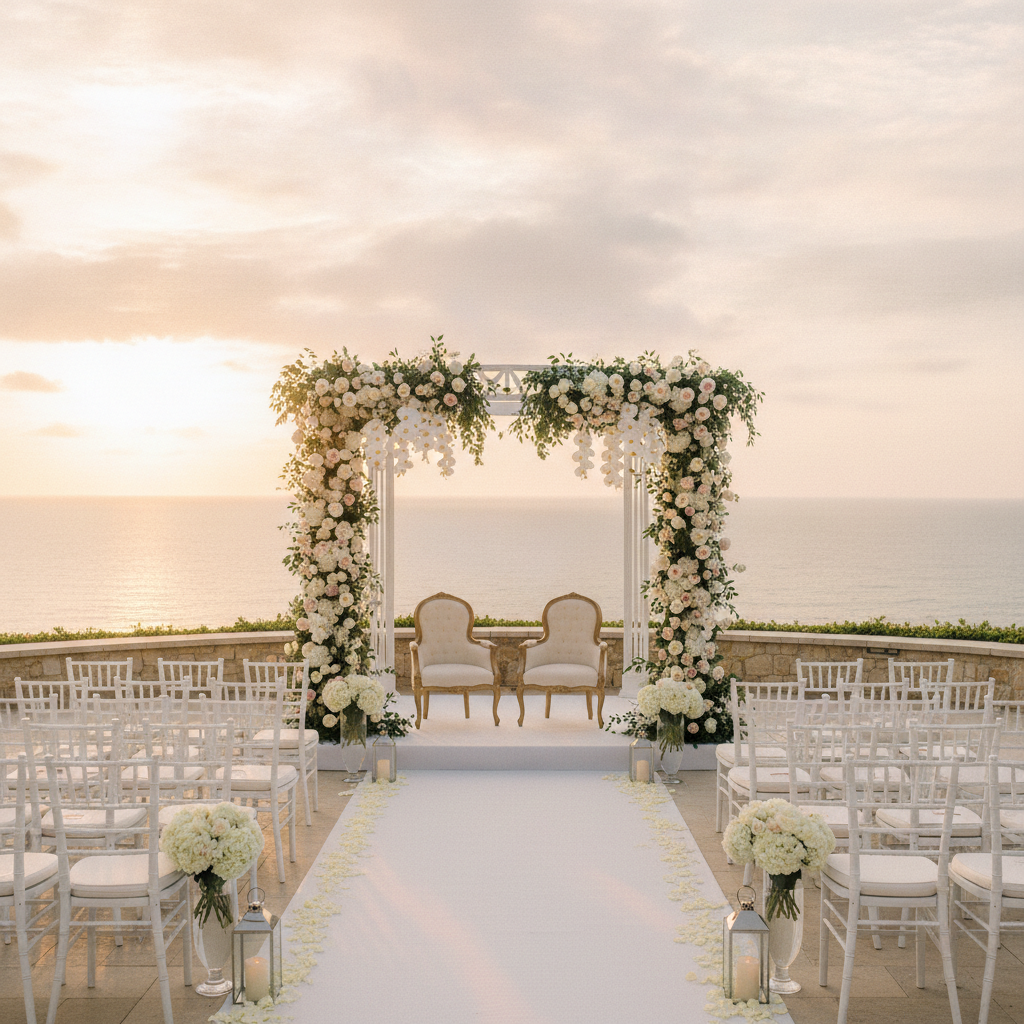
Udaipur and Goa are among the destinations featured in Patel Events’ portfolio. A couple considering a palace or heritage venue should ask about access, rigging, noise, guest movement, and indoor alternatives early. A couple considering Goa should discuss monsoon conditions, wet-weather layouts, humidity-sensitive flowers, outdoor sound, and any restrictions on beach or terrace production before signing a brief.
12–18 months out: choose the destination, legal route, and venue
The first phase creates the boundaries for every later choice. Begin with a realistic guest list and a clear view of what the couple, parents, or other contributors are paying for. A destination that looks affordable for the couple may be difficult for guests once flights, rooms, transfers, outfits, and time away from work are included.
Choose a destination around the guest experience
Compare airports, transfer time, direct-flight options, accommodation at different price points, accessibility, climate, and the amount of time guests will need away from home. Older relatives may need shorter transfers, shaded seating, lifts, quiet rooms, or a place to rest between ceremonies. Children and guests unfamiliar with the destination benefit from simple directions and a named contact on arrival.
Do not choose a venue solely from photographs. Ask for a site plan showing ceremony, dining, dancing, guest rooms, toilets, service access, power, and rain cover. Request recent information about local noise curfews, permitted music hours, fire or havan policies, drone restrictions, and the route suppliers will use to bring in decor and technical equipment.
Decide whether the marriage is legal abroad or in the UK
The legal route affects paperwork, timing, ceremony language, witnesses, and the documents you must carry. Couples should ask the destination authority or an appropriately qualified adviser what applies to their nationality and circumstances. Requirements can include a certificate of no impediment, document certification, translations, local notice, witnesses, or a period of residence, but the exact list varies by country.
In England and Wales, couples must decide where to hold the ceremony before giving notice, as explained in the GOV.UK ceremony-planning guidance. Some UK-based couples therefore complete their legal civil ceremony at home and hold a symbolic destination ceremony, while others choose to complete the legal process abroad. Neither approach should be treated as universal; confirm the route before making promises to guests or printing ceremony details.
Reserve the venue and accommodation approach
- Request a written rain plan for every outdoor ceremony, including the time required to move furniture, mandap elements, guests, and technical equipment.
- Confirm whether the venue supplies tables, chairs, linen, staging, power, generators, lighting, sound, and staff, or whether those items need separate suppliers.
- Ask how late music may run and whether live dhol, DJ sound, fireworks, candles, havan, or amplified recitations need approval.
- Check room release dates, payment deadlines, cancellation terms, accessible rooms, breakfast, airport transfers, and options for guests who want to stay elsewhere.
- Record loading routes, lift dimensions, rigging points, storage areas, vehicle restrictions, and the person who signs off deliveries.
Appoint one accountable planning lead
Multiple suppliers can each be excellent and still leave gaps between their responsibilities. A planning lead should own the master timeline, supplier brief, guest logistics, approvals, ceremony flow, production schedule, and escalation process. Patel Events coordinates destination events, weddings and Sangeets, Nikkah ceremonies, Gujarati weddings, cinematography, and DJ production, allowing couples to review one joined-up plan rather than several disconnected schedules.
Use a decision calendar from the beginning. For example, hold monthly design approvals, schedule regular venue or video walk-throughs, set deadlines for family feedback, and require a final production sign-off. The wedding-day coordination checklist is useful when assigning cues, handovers, and responsibilities across the final run-of-show.
6–9 months out: build the South Asian ceremony plan
When a wedding includes a Nikkah, Sangeet, Gujarati rites, and reception, treat each event as its own production while keeping one master schedule. Confirm what is religiously required, what is customary for the family, what the venue permits, and what guests need to understand. Then translate that information into timings, layouts, sound cues, staffing, and guest movement.
Nikkah planning checklist
- Confirm the officiant, documents, witnesses, recitation order, signing process, and the pronunciation of names.
- Agree the seating arrangement, privacy preferences, prayer space, ablution access, and route for the couple and immediate family.
- Place microphones so the officiant and couple can be heard without making the ceremony feel over-produced.
- Prepare a signing table, suitable pens, document protection, and a photo position that does not interrupt the proceedings.
- Brief the photographer and filmmaker on respectful movement, restricted areas, and moments that should not be staged or repeated.
Couples can use the Nikkah ceremony planning checklist to discuss the order of the ceremony and the practical questions that need family approval.
Sangeet planning checklist
- Collect performances, entrances, speeches, and tracks in one labelled folder with a second copy available offline.
- Build a running order that protects sound checks and leaves clear transitions between acts. The emcee should know who is next and who has authority to shorten a segment.
- Check dance-floor surface, stage access, lighting positions, cable protection, power, and a backup plan for a delayed or unavailable performer.
- Schedule mehndi, rehearsals, meals, and outfit changes so performers are not asked to move directly from one commitment to another.
- Agree the point at which the DJ, band, dhol player, stage manager, and venue team hand over control.
Gujarati wedding and mandap planning checklist
- Confirm the family’s ceremony order, including welcome procession, antarpat, kanya aagman, pheras, blessings, and any additional rites.
- Measure the mandap and aisle, then test whether the layout allows the couple, priests, family, photographers, and guests to move safely.
- Prepare a labelled puja kit with spare small items and identify who is responsible for transporting it.
- Discuss havan, flame, incense, floral, and safety requirements with the venue well ahead of arrival.
- Provide shade, water, seating, and a clear route for elders. Check the sun position and heat at the ceremony time rather than relying only on a morning site visit.
Reception planning checklist
Build the reception around guest energy and meal service. Sequence entrances, welcome remarks, toasts, first dance, meal courses, cultural performances, and open dancing with the caterer, emcee, DJ, and photographer. A realistic running order allows the couple to eat, greet guests, and take portraits instead of being moved continuously from one cue to the next.

3–6 months out: lock design, florals, media, and technical production
At this stage, the wedding should move from broad ideas to measurable specifications. A mood board is not enough for a destination supplier team: record dimensions, quantities, materials, colours, delivery times, installation responsibilities, removal times, and the person approving substitutions.
Coordinate decor and florals across several events
Create a visual story that can change tone without requiring a completely new event infrastructure each day. For example, the Nikkah may use restrained florals and softer lighting, the Sangeet may introduce colour and movement, and the reception may return to a more formal palette. Reusing suitable structures, candles, plinths, or signage can reduce transport and installation pressure, but only if the schedule permits a safe reset.
Climate changes the design brief. Humidity can shorten the life of delicate flowers and affect paper goods, fabrics, electronics, and makeup. Dry heat and wind can damage petals, loosen temporary structures, and make an uncovered mandap uncomfortable. The wedding decor planning checklist can help organise the conversation about layouts, rentals, floral details, installation, and contingency choices.
Prepare a photography and cinematography brief
- List non-negotiable moments: signing, entrances, pheras, family blessings, speeches, first looks, performances, and the couple’s private portraits.
- Mark respectful camera positions and restricted spaces for religious ceremonies. Confirm whether drones, tripods, flash, or additional lighting are permitted.
- Walk routes for the couple, procession, photographers, and videographers so equipment does not block guests or ceremony participants.
- Schedule portraits around heat, light, meal service, outfit changes, and the couple’s need for breaks.
- Store music, speeches, contact details, and the shot list in a shared offline-accessible folder in case connectivity fails.
Check sound, power, and backup equipment
Destination production fails when technical assumptions remain vague. Confirm the number and location of power outlets, generator responsibility, cable routes, rain protection, microphone frequencies, speakers, monitors, lighting control, and the equipment that will be available if a shipment is delayed. A local equivalent for a critical cable, mixer, controller, microphone, or playback device can protect the event even when the main supplier is travelling.
Run an audio test in the actual ceremony and reception spaces. Heritage rooms, courtyards, beaches, and terraces produce very different sound conditions. Test the officiant’s microphone, speeches, music playback, dhol or live instruments, and emergency announcements, then record who has authority to pause or change the programme if sound or weather becomes unsafe.
4–8 weeks out: final guest logistics and on-site coordination
The last two months are for confirmation, not fundamental redesign. Use one mobile-friendly guest guide containing the schedule, venue maps, airport and transfer instructions, hotel details, dress codes, weather expectations, dietary contact, prayer information where relevant, and a WhatsApp or telephone helpline. Send a final version about two weeks before travel and keep a small printed supply for guests who need it.
Confirm the guest journey
- Reconcile the final rooming list with the venue and confirm check-in, late arrival, accessible-room, and transfer requirements.
- Create airport transfer groups with flight numbers, luggage expectations, vehicle capacity, and a named greeter or local contact.
- Mark guests who need extra support, including older relatives, children, mobility assistance, medication storage, or quiet accommodation.
- Share local currency, power-adapter, eSIM or SIM, weather, clothing, and hydration advice without overwhelming guests with unnecessary detail.
- Prepare a contact tree so guests know whom to call for transport, hotel, ceremony, medical, or lost-item questions.
Lock the event documents
Prepare one master production folder containing the venue plan, supplier contacts, payment status, rooming list, seating plan, ceremony scripts, cue sheets, menus, dietary notes, shot list, delivery schedule, emergency contacts, and weather alternatives. Give each supplier only the information they need, but make sure the planning lead has the complete version.
Pack ceremony and comfort kits separately. Include ritual items, spare stationery, safety pins, fashion tape, sewing supplies, charging banks, adapters, basic first-aid supplies, garment protection, printed contacts, and copies of documents where appropriate. Keep essential items in hand luggage when possible rather than relying on checked bags or a shipment that may be delayed.
Use arrival week to test the plan
On arrival, walk the venue with the planner, venue manager, production lead, decor team, and ceremony representatives. Check the actual floor, sun, wind, guest routes, furniture, power, sound, toilets, catering access, and rain plan. Brief family members on where they need to be and when, then hold a short rehearsal for entrances, processions, signing, pheras, speeches, and any complex transitions.

What does a full-service destination planner handle?
A full-service planner does not replace the couple’s decisions; they turn those decisions into a coordinated operating plan. The greatest value is often found between suppliers: checking that the floral installation fits the venue, that the mandap leaves room for the camera team, that the DJ has the correct stage plot, and that the guest shuttle does not leave before the reception’s final event.
| Planning area | Couple or family may manage alone | Planner-led coordination adds |
|---|---|---|
| Venue | Compare photographs, menus, dates, and quoted inclusions. | Site plans, access checks, contingency layouts, load-in timing, and venue handovers. |
| Ceremonies | Choose the ritual order and family participants. | Timed scripts, entrances, microphones, rehearsal, stage management, and respectful supplier briefing. |
| Design | Select colours, mood, flowers, and key visual references. | Measured specifications, rental coordination, installation sequencing, substitutions, and resets between events. |
| Guests | Collect RSVPs and share travel information. | Rooming, transfers, contact trees, accessibility notes, arrival support, and real-time problem solving. |
| Production | Choose a DJ, filmmaker, photographer, or entertainment. | Integrated schedules, technical riders, backup equipment, cue sheets, sound checks, and vendor accountability. |
Patel Events brings more than 27 years of experience, has delivered more than 500 events, and coordinates a network of more than 50 trusted vendors, according to the business information supplied for this article. The team supports London, Leicester, Kent, and Tooting clients as well as destination celebrations in India and overseas. Those facts describe the company’s stated experience and service scope; couples should still ask for a proposal that names the specific team, suppliers, inclusions, and destination responsibilities for their event.
Frequently asked questions about a destination wedding checklist
How early should we start a destination wedding checklist?
Start 12–18 months before the preferred date where possible. That gives you time to compare destinations, check the legal route, reserve the venue and accommodation, secure headline suppliers, and give guests a realistic opportunity to budget and travel.
Is it better to marry legally in the UK or abroad?
There is no single answer for every couple because destination rules depend on nationality, location, documents, and ceremony type. Some UK-based couples complete the civil marriage in the UK and hold a symbolic ceremony abroad; others complete the legal process overseas. Confirm the requirements with the relevant authorities before choosing a route, date, or ceremony wording.
How do we coordinate a Nikkah, Sangeet, Gujarati wedding, and reception?
Create one master schedule and a separate production brief for each event. Confirm ritual order, entrances, music, microphones, layouts, photography boundaries, family responsibilities, meal timing, and rehearsals, then appoint one person to call cues and resolve clashes on site.
What should be in the final guest information pack?
Include the event schedule, venue and hotel details, airport transfers, maps, dress codes, weather guidance, accessibility information, dietary contact, prayer or cultural information where relevant, emergency contacts, and a helpline. Keep the guide mobile-friendly, issue the final version about two weeks before travel, and provide a named arrival contact.
Turn your checklist into a coordinated destination plan
If you are planning a destination wedding from Harrow, London, or elsewhere in the UK, Patel Events can help turn the checklist into a joined-up plan for ceremony flow, decor, florals, cinematography, DJ production, suppliers, and guest logistics. Book a conversation with Patel Events to review your destination, date, guest profile, and the planning responsibilities that need to be covered before travel.